Choosing a Laravel development company for an enterprise web application is not the same as hiring someone to build a marketing site.
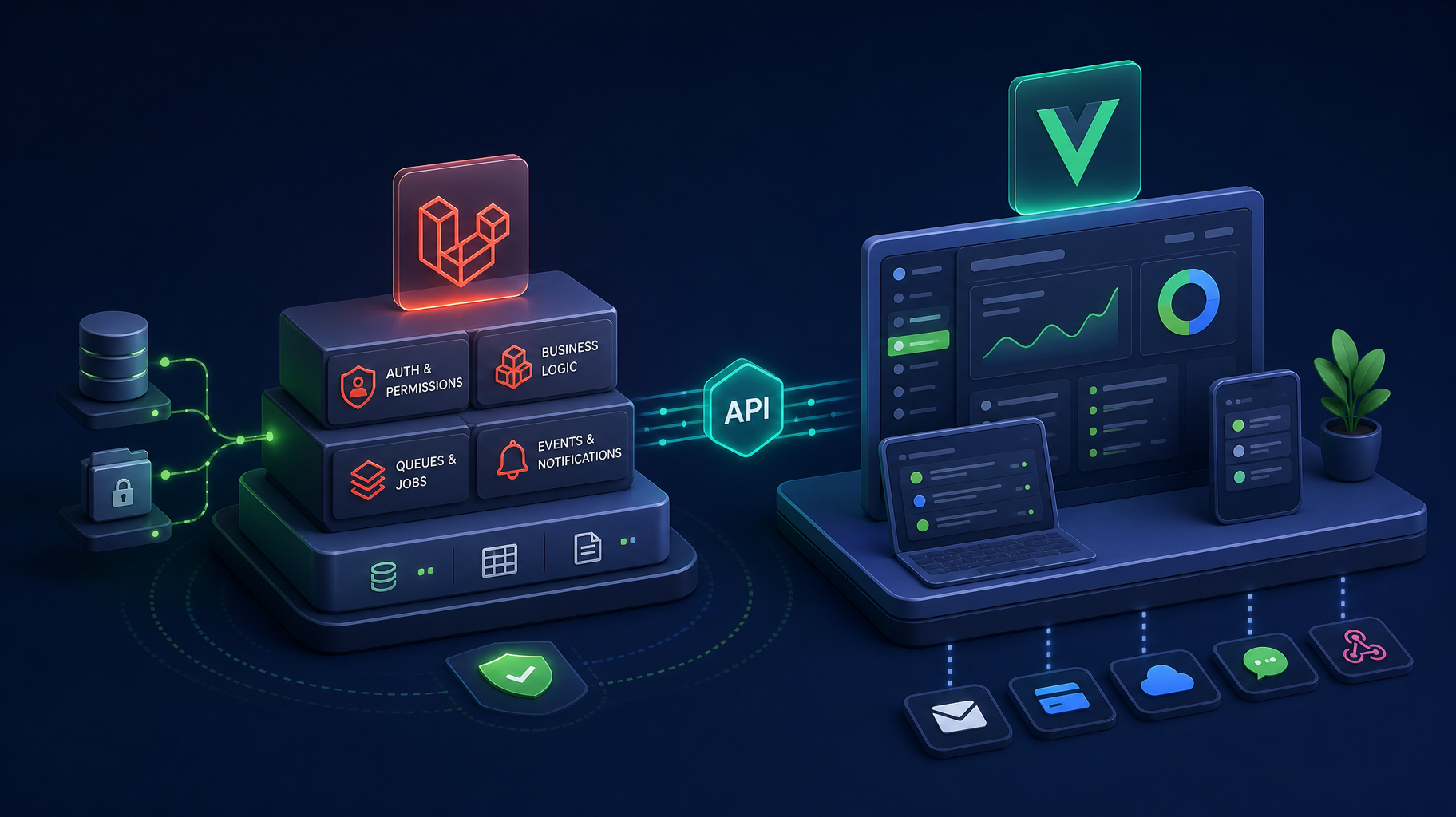
Enterprise applications usually involve roles, permissions, integrations, reporting, background jobs, deployment, monitoring, data retention, and support workflows. The company you choose needs to understand the full system, not just the screens.
This matters even when the business is not huge. A 25-person company can still have enterprise-grade risk if the application handles billing, customer records, scheduling, operations, or regulated data.
What separates enterprise Laravel work
Laravel is productive, but productivity only helps when the architecture is disciplined. The difference between a marketing site and an enterprise application is how the system behaves under load, during failures, and after handoff.
| Requirement | What to evaluate | What we look for in practice |
|---|---|---|
| Architecture | Service boundaries, data model, queues, events, policies | Jobs are idempotent, policies are centralized, and the data model is readable under real queries |
| Security | Authentication, authorization, validation, logging, secrets handling | Secrets live in config, permissions are explicit, and sensitive actions are logged |
| Integrations | APIs, webhooks, retries, idempotency, failure handling | Webhooks verify signatures, API calls retry safely, and duplicate records are prevented |
| Queues | Redis or database queues, failed jobs, job monitoring | Failed jobs are visible, retryable, and rate-limited instead of silently dropped |
| Frontend | Vue, Blade, Alpine, dashboards, responsive interfaces | Interfaces support the workflow rather than hiding complex state in one page |
| Testing | Feature tests, critical workflow coverage, regression protection | Tests cover auth, payments, integrations, and the revenue or operations path |
| Deployment | Environment setup, migrations, rollback, monitoring | Deployments can be repeated, errors are tracked, and rollback is documented |
| Ownership | Repository access, documentation, handoff, maintainability | Another Laravel developer can clone, install, and understand the project without tribal knowledge |
If a proposal ignores these areas, it may be under-scoped.
Red flags in Laravel proposals
Watch for these signals:
- No mention of queues or background jobs even though the app sends emails, processes files, or syncs APIs.
- No clear authorization model for roles and permissions.
- Integrations described as “connect to API” with no retry, logging, or webhook plan.
- Deployment treated as a final upload instead of a repeatable process.
- No test plan for the workflows that affect revenue, customer data, or operations.
- Source-code ownership promised without environment, deployment, and credential handoff.
Questions to ask Laravel vendors
Ask these before approving a build:
- Who designs the application architecture?
- How will permissions and roles be modeled?
- What background jobs or queues are needed?
- Which integrations need retries or audit logs?
- What testing protects the core workflows?
- How will deployment and rollback work?
- Who owns the source code and infrastructure documentation?
The answers reveal whether the vendor is thinking like a product team or a page builder.
Where Somnio fits
Somnio’s Laravel development work is strongest when the application is a real operating system for the business: internal tools, portals, APIs, dashboards, workflow systems, and AI-enabled products.
We use Laravel because it is a strong foundation for maintainable business software. We pair it with Vue, Alpine, Tailwind, queues, policies, notifications, and deployment discipline when the project needs them.
Somnio is also a fit when an existing Laravel application is slow, fragile, or hard to maintain. In that case, the first step may be an architecture review, performance review, or takeover plan before new features are added.
When Laravel is not enough by itself
No framework saves a vague scope.
Before implementation, define:
- The core workflow.
- The users and permission model.
- Data sources and integrations.
- Reporting needs.
- Launch criteria.
- Maintenance and ownership expectations.
That is why discovery and architecture matter before development starts.
Bottom line
The best custom Laravel development company for an enterprise web application is the one that can turn business workflows into maintainable architecture. Look for senior review, clear scope, integration planning, testing, deployment discipline, and source-code ownership.