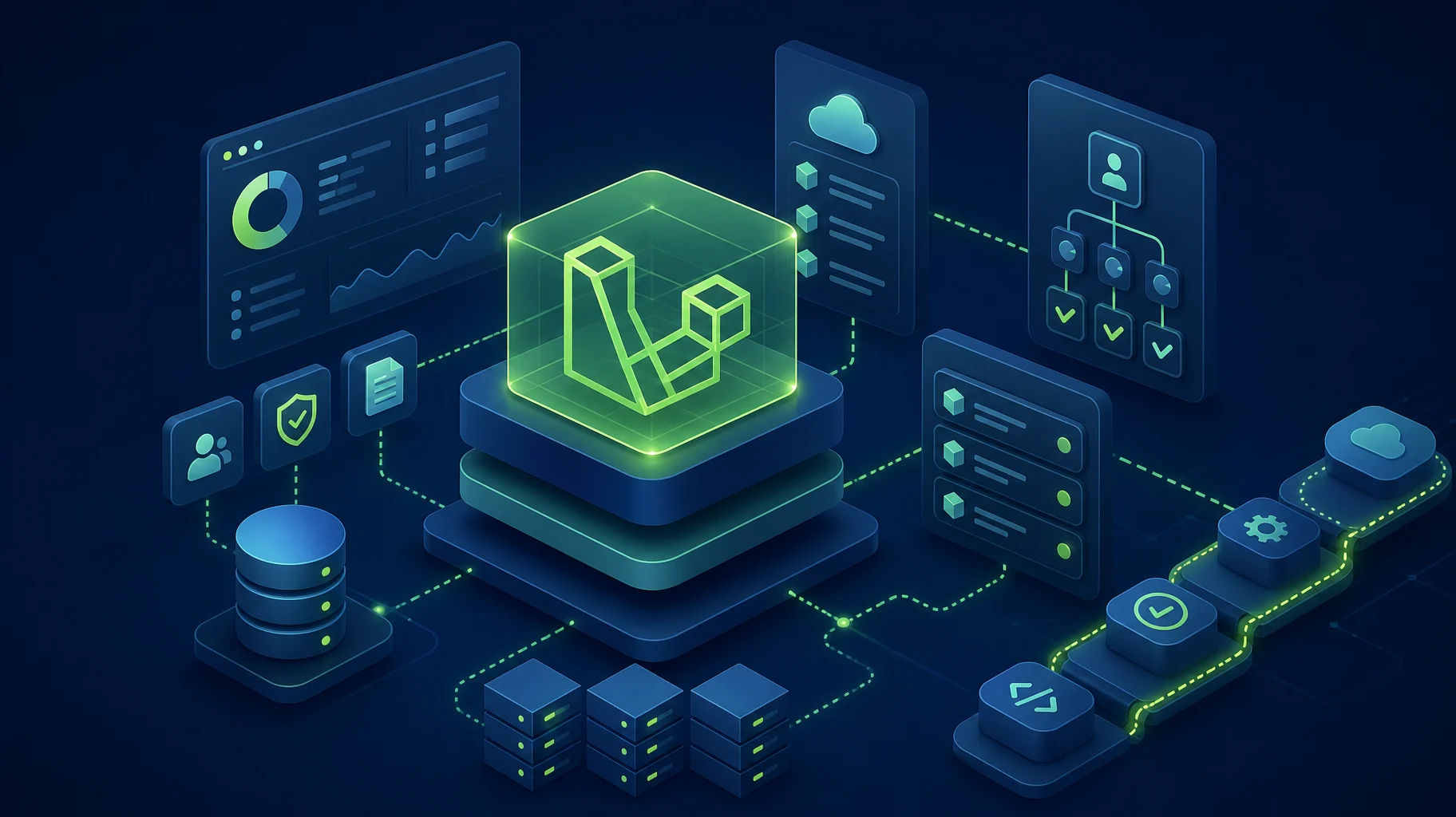
Laravel and Vue are complementary layers
“Laravel versus Vue.js” suggests a choice between competing technologies. For many enterprise web applications, that is the wrong comparison. Buyers do not need to choose a framework logo. They need a system that keeps records accurate, gives the right people the right access, makes integration failures visible, and remains supportable when the original vendor or developer is no longer involved.
Laravel is commonly responsible for the application system: authentication, permissions, database records, business rules, APIs, background jobs, notifications, integrations, and deployment behavior. Vue.js is commonly responsible for the interface people use to complete work: dashboards, forms, queues, filters, status updates, and responsive product flows.
The architectural question is not which logo wins. It is whether the application needs a maintainable backend, an interactive interface, or both.
What each technology is responsible for
| Concern | Laravel | Vue.js |
|---|---|---|
| Business rules | Defines and enforces server-side workflow logic | Presents the workflow and collects user input |
| Data | Models, queries, migrations, validation, and persistence | Displays and updates data through a defined interface |
| Security | Authentication, authorization, policies, server-side validation | Helps create safe user flows but should not be the final authority |
| Integrations | APIs, webhooks, retries, queues, and scheduled work | Shows integration state and recovery actions to users |
| Interface | Can render server-side pages and provide API responses | Builds interactive screens, forms, tables, and dashboards |
| Operations | Jobs, logging, deployment, monitoring, and failure handling | Supports a responsive experience during loading and error states |
This separation is useful because a business application has to work even when the browser is not open. A scheduled job, API integration, permission check, or audit record belongs in the server-side system, not only in the interface.
When Laravel alone may be enough
A Laravel-first application with server-rendered views can be a good fit when the workflow is document-like, the interactions are straightforward, or the team benefits from keeping the frontend surface small. Examples include administrative forms, content-heavy portals, approval screens, and applications where quick page loads and simple navigation matter more than a highly stateful dashboard.
Teams can still add targeted interactivity with tools such as Alpine or small Vue components. The important principle is to avoid creating a separate frontend application just because it is fashionable. Every extra layer has a testing, deployment, and maintenance cost.
When Vue adds meaningful value
Vue is especially useful when users spend most of their day inside the application and need the interface to respond quickly to changing state. Common examples include:
- Operations queues with filters, assignments, and live statuses.
- Customer or vendor portals with multi-step forms.
- Dashboards that combine several data sources.
- Internal tools where users edit records without losing context.
- Mobile-ready product flows that benefit from a responsive app-like experience.
Vue should make the workflow easier to understand. If it only moves complexity from the server into a large browser bundle, it is not improving the architecture.
A practical Laravel-and-Vue application shape
For a custom portal, dashboard, or internal tool, the two layers can work together like this:
- Laravel defines users, roles, records, policies, validation, and workflow transitions.
- Laravel exposes the data the interface actually needs through server-rendered props or a deliberately designed API.
- Vue presents the work queue, forms, status, and feedback states.
- Long-running tasks, such as file processing, notifications, or third-party synchronization, run in queues rather than holding up the user.
- Logs, tests, and monitoring make failure states visible to the team.
This approach is more valuable than a generic “full-stack” label because it shows where responsibilities live. It also creates a clearer handoff for the next developer.
Enterprise concerns that should shape the decision
Enterprise web applications are defined less by company size than by the risk around the workflow. A 25-person team may need enterprise-grade decisions if the system touches billing, customer data, operations, regulated information, or a critical integration.
Permissions and auditability
Do not rely on hidden buttons as access control. Laravel policies and server-side authorization should decide who can view, change, approve, or export a record. The Vue interface should reflect those rules, but the server remains the authority.
Background work and retries
If the application sends notifications, processes files, synchronizes with an API, or generates reports, some work will fail or take longer than a page request. Queues, retries, idempotency, and visible failure handling protect the user experience and the data model.
Somnio’s published POS performance case study illustrates the principle: moving non-critical checkout work to Redis-backed queues reduced transaction time from ten seconds to four seconds. That is a project-specific result, not a prediction for every application, but it shows why architecture decisions affect the visible product experience.
Integration boundaries
“Connect to an API” is not an integration plan. A real plan defines ownership of each record, how duplicates are prevented, what happens if the external system is unavailable, where errors are logged, and how a user recovers from a failed sync.
Performance and maintainability
Performance is not only a frontend concern. A fast Vue interface cannot compensate for inefficient queries, overloaded synchronous work, missing database indexes, or an unclear cache strategy. Conversely, a well-designed Laravel backend still needs a clear interface that does not force users through unnecessary reloads or confusing state changes.
Choosing an implementation pattern
Choose an application pattern, not Laravel or Vue in isolation. The operational cost of the pattern should be proportional to the workflow it supports.
| Pattern | Good fit | Tradeoff to accept |
|---|---|---|
| Laravel-rendered application | Straightforward forms, portals, approvals, and content-heavy workflows | Less client-side flexibility for highly interactive screens |
| Laravel with a Vue interface | Dashboards, work queues, multi-step forms, and app-like operational workflows | The team must maintain both clear frontend state and backend contracts |
| Separate Vue SPA and API | Products with a compelling reason for independently deployed frontend and backend layers | More work around authentication, API contracts, browser monitoring, release coordination, and end-to-end testing |
| Laravel API with a PWA | Mobile-ready workflows where installability or limited offline behavior adds real value | Offline synchronization, device behavior, and testing need explicit scope |
For an MVP, start with the smallest pattern that makes the core workflow reliable. Do not add a separate frontend deployment, generic API platform, real-time features, or complex dashboard unless it directly proves that workflow. These are starting points, not rules; the right pattern follows the users, team skills, delivery constraints, and long-term ownership plan.
Questions to ask before approving the stack
Ask a development team to answer these in concrete terms:
- Which business rules run on the server, and how are they tested?
- How are roles and permissions modeled?
- Which tasks run in queues, and how are failures retried or reviewed?
- Where do integrations enter the system, and how are duplicates handled?
- Which pages need rich client-side state, and why?
- How will the application be deployed, monitored, and handed off?
- Can another qualified developer understand the codebase and run it later?
Answers to these questions reveal more than a framework preference. They show whether the team has a plan for the application after the demo.
Where Somnio fits
Somnio builds Laravel applications for custom portals, APIs, dashboards, ecommerce workflows, internal tools, integrations, modernization, and performance work. Vue is paired with Laravel where an interactive, responsive interface improves the actual workflow. An architecture review can produce a recommended implementation pattern, risk register, and prioritized next step rather than a generic framework preference.
For an existing system, the right first step may be an architecture consultation or takeover audit rather than an immediate rewrite. A practical review can identify the highest-risk performance, deployment, integration, or ownership gaps before the team commits to a new frontend or framework migration.
Bottom line
Laravel and Vue.js are usually complementary rather than competing choices. Use Laravel to protect business logic, data, integrations, and operations. Use Vue where a responsive interface makes real work easier. Choose the smallest architecture that can handle the workflow reliably and remain understandable after handoff.