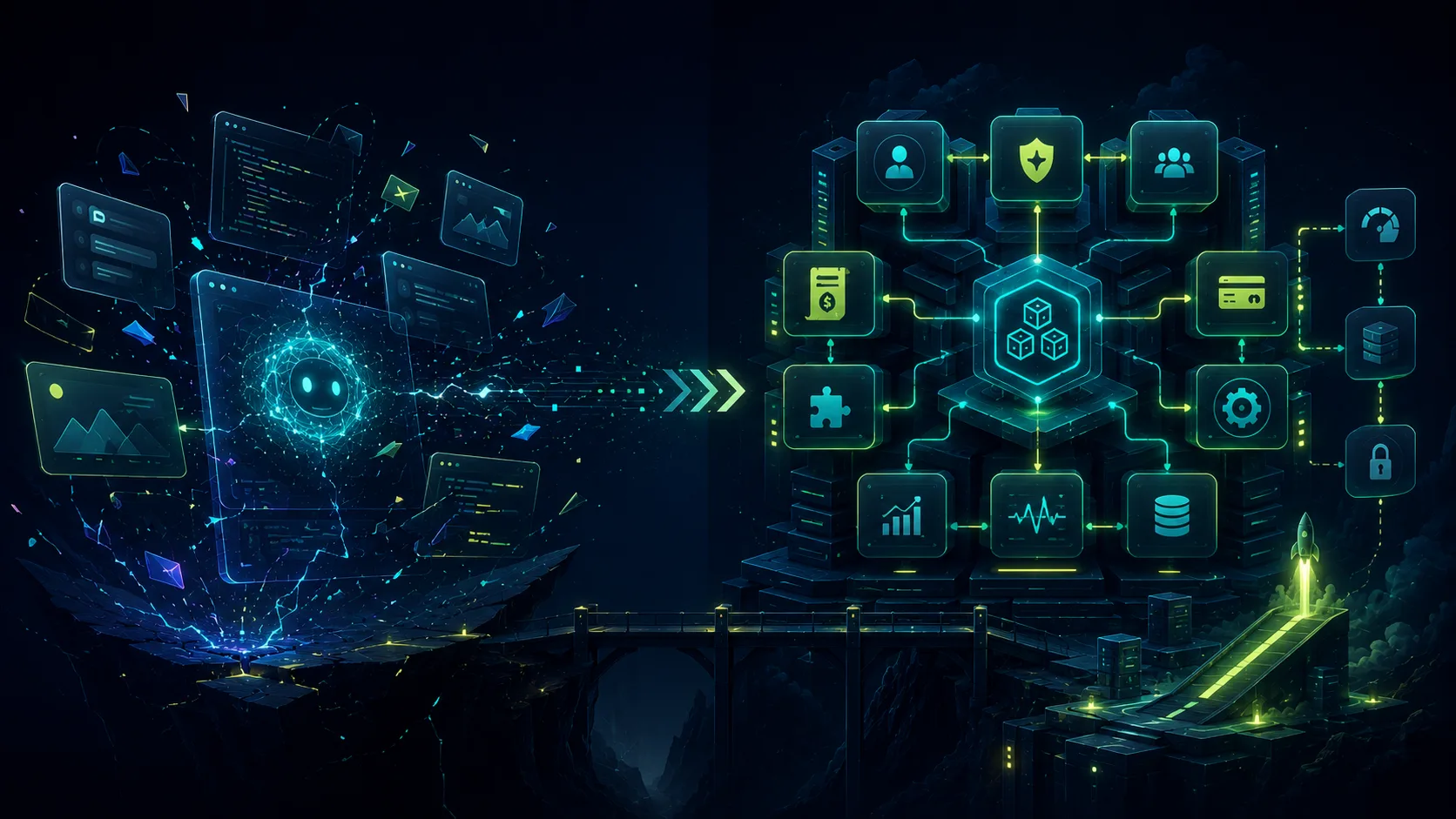
The direct path: one product loop, not a feature catalog
Start with the deliverables, not a countdown. Somnio’s general MVP development serves nontechnical founders with project-specific pricing and timelines. The 12-week plan below is a planning example, not a universal delivery commitment. The published $20K starting guidance and 12-week target belong only to the focused AI MVP specialization when requirements fit.
To launch an MVP in 12 weeks, define the one user action that proves the product is useful. That might be a customer submitting a request and receiving a useful result, an operations team completing an intake workflow, or a manager seeing an accurate dashboard without a manual report.
Everything else has to earn its place around that loop. A polished backlog is not an MVP plan. A launchable plan names the user, the trigger, the input, the outcome, the systems involved, and the evidence that the workflow worked.
Somnio’s 12-week AI MVP package is built around this constraint: a fixed-scope product release with Laravel, Vue.js or a PWA frontend, selected integrations, QA, deployment, and source-code handoff. It is a fit only when the first release can be clearly bounded.
Does your MVP fit in 12 weeks?
Use this fit test before treating a 12-week plan as a budget or launch commitment. A focused release is more likely to fit when you can say yes to most of these questions:
- Is there one primary user and one end-to-end workflow to prove?
- Can you name the first release’s one or two launch-critical integrations?
- Is a decision-maker available to review progress and resolve tradeoffs every week?
- Can the team provide access to the required systems, data, and subject-matter experts?
- Are user roles, launch criteria, and important exclusions clear enough to write down?
- Can large migration work, native app-store release, regulated compliance programs, SSO, and high-availability requirements be deferred or separately scoped?
If the answer is no, that does not mean the idea is weak. It means discovery, a functional prototype, or a phased plan is the safer use of budget. Somnio’s focused package starts at $20,000 when the requirements fit; integration depth, AI complexity, data requirements, and launch scope are the main cost drivers beyond that starting point.
Start with a launch sentence
Before discussing screens or models, write one sentence in this form:
For [specific user], the first release lets them [complete a valuable workflow] using [key input or system], so they can [measurable or observable outcome].
For example: “For dispatch staff, the first release lets them review and assign incoming delivery exceptions from one queue so customers receive a confirmed resolution without staff copying details between email and spreadsheets.”
This is not marketing copy. It is a scope test. If the sentence requires three user types, eight integrations, or every future feature, it is describing a roadmap rather than an MVP.
A practical 12-week MVP plan
The weeks do not all carry the same risk. The early weeks protect the rest of the schedule by settling decisions that are expensive to change later.
| Phase | Weeks | Decision to make | Evidence of progress |
|---|---|---|---|
| Scope and architecture | 1-2 | What is the first product loop, and what is excluded? | Written scope, acceptance criteria, data and integration plan |
| Core build | 3-6 | Can users complete the primary workflow? | Demo-ready flows with accounts, roles, and real data paths |
| Integrations and hardening | 7-9 | Does the product behave correctly outside the happy path? | Working integrations, error states, feedback or analytics |
| QA, launch, and handoff | 10-12 | Can the team operate and improve the product after launch? | Tested critical paths, deployment plan, documentation, handoff |
This is consistent with Somnio’s public MVP delivery process, but the exact work changes with the product. A simple internal workflow may need more integration testing than interface design. A customer-facing AI product may need more attention to data boundaries, cost controls, and fallback behavior.
Weeks 1 and 2: reduce uncertainty before writing features
The first two weeks should answer the questions that make a fixed timeline credible:
- Who is the first real user?
- What is the one workflow they must complete?
- Which information must the product store, and where does it come from?
- Which integrations are launch-critical versus convenient?
- Which decisions need human review rather than automation?
- What makes the release acceptable to launch?
- What is explicitly deferred?
The output should be more useful than a feature list. It should include a workflow map, user roles, acceptance criteria, assumptions, integration responsibilities, and a change process. If those answers are unknown, start with discovery rather than pretending that a fixed build has already been scoped.
For an internal operations MVP, name a process owner and staff test users as well as a product owner. Use representative but safe sample data during build, and decide early how customer, employee, financial, or regulated information will be handled. An intake, approval, dispatch, or reporting tool can be a valid MVP when it removes one repeated handoff without trying to replace every system the team already uses.
Weeks 3 through 6: build the boring foundations early
Founders often want to start with the most impressive AI feature or dashboard. That can be useful for a demo, but it leaves too much production work for the end. Build the foundations that let real people use the core workflow first:
- Authentication and user roles.
- The data model and primary records.
- The main workflow and its status changes.
- Validation and permissions.
- The one or two integrations required for the workflow.
- A reviewable interface for the person who owns the outcome.
For a Laravel product, this often means building policies, database relationships, queued work, notifications, and API boundaries alongside the visible Vue or PWA screens. The goal is not to make the codebase elaborate. The goal is to avoid a demo that cannot handle an account, a failed request, or a real handoff.
Weeks 7 through 9: make the product reliable enough to learn from
An MVP does not need every feature, but it must produce trustworthy feedback. Add the paths that let the team understand what happens when real inputs arrive:
- Connect approved third-party systems and handle failures visibly.
- Add a clear empty state, validation messages, and recovery path.
- Capture the feedback or event data needed to judge the workflow.
- Test permissions and the highest-risk data changes.
- Decide what runs synchronously and what should run in the background.
AI products need a few additional boundaries. Define what data reaches the model, what a good output looks like, what the user sees when output is slow or poor, and how usage or cost is observed. AI is valuable when it improves a specific judgment-heavy step, such as extracting, classifying, summarizing, or drafting. It should not replace deterministic business logic that needs predictable results.
Weeks 10 through 12: launch work is product work
Do not reserve the final fortnight for “polish.” Launch work is part of the MVP scope:
- Test the critical user path from first sign-in to successful outcome.
- Test failure paths for missing data, permission mistakes, unavailable integrations, and retryable background work.
- Confirm how the application is deployed, monitored, and rolled back.
- Document repository access, environment responsibilities, and the next support path.
- Run a short real-user launch with a way to collect feedback.
Somnio’s published MVP delivery model includes agreed QA, production deployment, documentation, source-code handoff and deployment instructions. That matters because a future developer needs more than the visible screens to run or extend the product.
What should actually arrive at MVP launch?
For a nontechnical founder, the useful launch question is: “Can my first users finish the task, and can I operate what we built?” Ask for a delivery plan you can check without reading code:
- A usable core journey: demonstrate the agreed task with representative data, including the permissions and failure states it requires. A clickable demo is not the production release.
- The live application: confirm its production address, hosting responsibilities and expected workload. An MVP is not a promise of unlimited scale.
- Evidence against the requirements: review critical-path tests and acceptance checks, not just a list of completed screens.
- Source and operating context: receive source code, documentation and deployment instructions. Confirm repository access, credentials and production account arrangements in the delivery plan rather than assuming they transfer automatically.
- A clear next step: record known limitations, deferred features and how feedback will be captured where included in scope. Launch does not guarantee adoption or revenue.
Upon full payment, you own custom code developed specifically for your project under the signed agreement. Somnio retains its development methodologies and proprietary tools; open-source components retain their respective licenses. Hosting, model/API usage and other third-party charges are identified separately. The handoff guide explains what your next developer will need.
A launch lesson from an operational project
In the published food-processing PWA study, staff needed to enter production data when the network dropped. Offline storage and sync were part of the usable workflow, not later polish. The rollout began on one production line before expanding facility-wide.
This was a replacement of existing operational software, not a greenfield founder MVP. The study documents that rollout; it does not establish a founder handoff or ownership history. The transferable lesson is to test the user’s actual working conditions before broadening a release. The evidence here is the published case study, not an independent measurement report.
Defect correction is not an ongoing support plan
For 30 days after delivery, Somnio will correct verified defects at no charge when custom code does not function as specified in the agreed requirements.
New features, changed requirements and third-party service changes are excluded. A delivered workflow failing an agreed acceptance requirement is different from requesting another workflow. The signed agreement controls final warranty details. Ongoing maintenance and new development are separately scoped; a retainer is optional, not required for custom-code ownership or continuing with another qualified developer. Read the ownership and defect policy before signing.
Production-readiness exit criteria
Before launch, the team should be able to verify the following, rather than calling the release ready by intuition:
| Check | What good looks like |
|---|---|
| Critical workflow | Acceptance tests or repeatable checks cover the path users depend on |
| Access and secrets | Production access and credentials have named owners and are not trapped with one person |
| Failures | Important errors, failed jobs, and integration issues are visible and have an owner |
| Recovery | Backup, rollback, and support steps are documented for the chosen scope |
| Data and permissions | Sensitive records have the intended access controls and retention decisions |
| Handoff | Another qualified developer can access the repository, deployment notes, and operating context |
The scope rules that protect a 12-week schedule
The strongest timeline tool is a clear “not now” list. Keep the following outside the first release unless they are essential to the core product loop:
| Common request | Better MVP treatment |
|---|---|
| Every user role | Start with the roles required to complete and supervise the main workflow |
| Multiple integrations | Launch with the system that creates or completes the core record |
| Full reporting suite | Track a few decision-making metrics and add broader reporting after usage begins |
| Native mobile apps | Consider a responsive web app or PWA unless native hardware access is central |
| AI everywhere | Use AI for the one high-value, hard-to-code step and measure it |
| Future roadmap features | Capture them as priced follow-on decisions, not hidden commitments |
Scope control does not mean refusing new ideas. It means making their cost and timeline consequences visible before approval. That is the difference between prioritization and surprise.
What a realistic MVP can prove
By the end of a focused 12-week build, the useful proof is not “we built a lot.” It is evidence that the product loop works with real users:
- Users can complete the intended workflow without staff workarounds.
- The team can see whether the workflow creates value or friction.
- The core data, permissions, and integrations behave as expected.
- The product can be deployed, supported, and extended without starting over.
The next phase should follow that evidence. If users need a different workflow, add it because the first release taught you something. If usage reveals a performance or integration constraint, scope that specifically. A well-run MVP creates a better roadmap; it does not attempt to contain one.
When a 12-week MVP is not the right answer
Choose a different first step when the core user, workflow, or data is still unclear; when the project requires a large migration or regulated compliance program; or when the buyer cannot provide decisions and access during the build. A functional prototype, an architecture consultation, or a narrower discovery engagement can reduce those risks first.
Bottom line
A 12-week MVP is possible when the team protects one valuable user workflow from scope growth and treats architecture, QA, deployment, and handoff as launch requirements. Start with the smallest product that real people can use, learn from that release, and add the next phase with evidence instead of assumptions.
For a product idea or existing prototype, start with general MVP development. Learn how senior judgment shapes first-release scope, or explore the AI MVP specialization if model-driven features are central to your product. AI-assisted building is a delivery method; it does not mean your users need an AI feature.